
Firm Power

Modern life has an insatiable appetite for power. We’re racing toward AGI, reshoring critical manufacturing, electrifying transport, and building the compute infrastructure that will power the AI century. The strategic significance of firm power, the always-available, dispatchable electricity that keeps the lights on when the sun doesn’t shine and the wind doesn’t blow, cannot be overstated.
So what exactly is firm power?
Think of electricity like water in a city. Solar and wind are great. They’re like rainfall that fills the reservoirs for free. But you can’t run a hospital, a factory, or a hyperscale AI cluster on rainfall alone. You need reservoirs with pumps that deliver water 24/7, on demand, at the exact required pressure. Firm power is that reliable, controllable supply; the kind that comes from natural gas, nuclear, hydro, or other sources that can ramp up or down instantly and run continuously. Without it, the entire system becomes fragile.
Why is firm power so significant right now?
Because every major trend in the economy now demands it in unprecedented quantities and at unprecedented speed:
AI training and inference clusters need rock-solid, high-density power that never drops.
Reshored factories and advanced manufacturing require 24/7 reliability.
The grid itself needs firm capacity to balance the massive influx of intermittent renewables.
Data centers alone are a perfect example. New hyperscale facilities don’t just need “some power.” They need firm power at the scale of small cities, delivered exactly when the GPUs demand it.
But here’s the uncomfortable reality: the United States is facing a firm power emergency.
The supply chain for new firm generation has effectively collapsed just as demand has gone vertical. Grid interconnection queues in major markets such as PJM and ERCOT now extend 4–5 years. Need a large power transformer for a substation upgrade? Expect 3-year lead times. New gas turbines from traditional OEMs? Sold out until 2030.
We are watching a historic mismatch unfold in real time.
So what’s driving this crisis?
A perfect storm of converging forces:
Explosive AI-driven demand from hyperscalers.
The continued build-out of renewables that still require firm backup.
Decades of underinvestment.
Offshoring that atrophied America’s industrial base.
Geopolitical reality: while we debate permits, China added 315GW of solar in 2025 alone — more new capacity in a single year than most countries have in total.
This isn’t a temporary blip. It’s structural.
Why is this problem not going away?
Because the physics and timelines simply don’t line up.
By 2027, next-generation AI racks (NVIDIA’s Kyber architecture and beyond) will push toward 600 kW–1 MW per rack. That level of density changes everything. Solar plus batteries to firm that power would require significant land quantities per cluster.
Consider the following graph, which illustrates projected U.S. data center power demand.
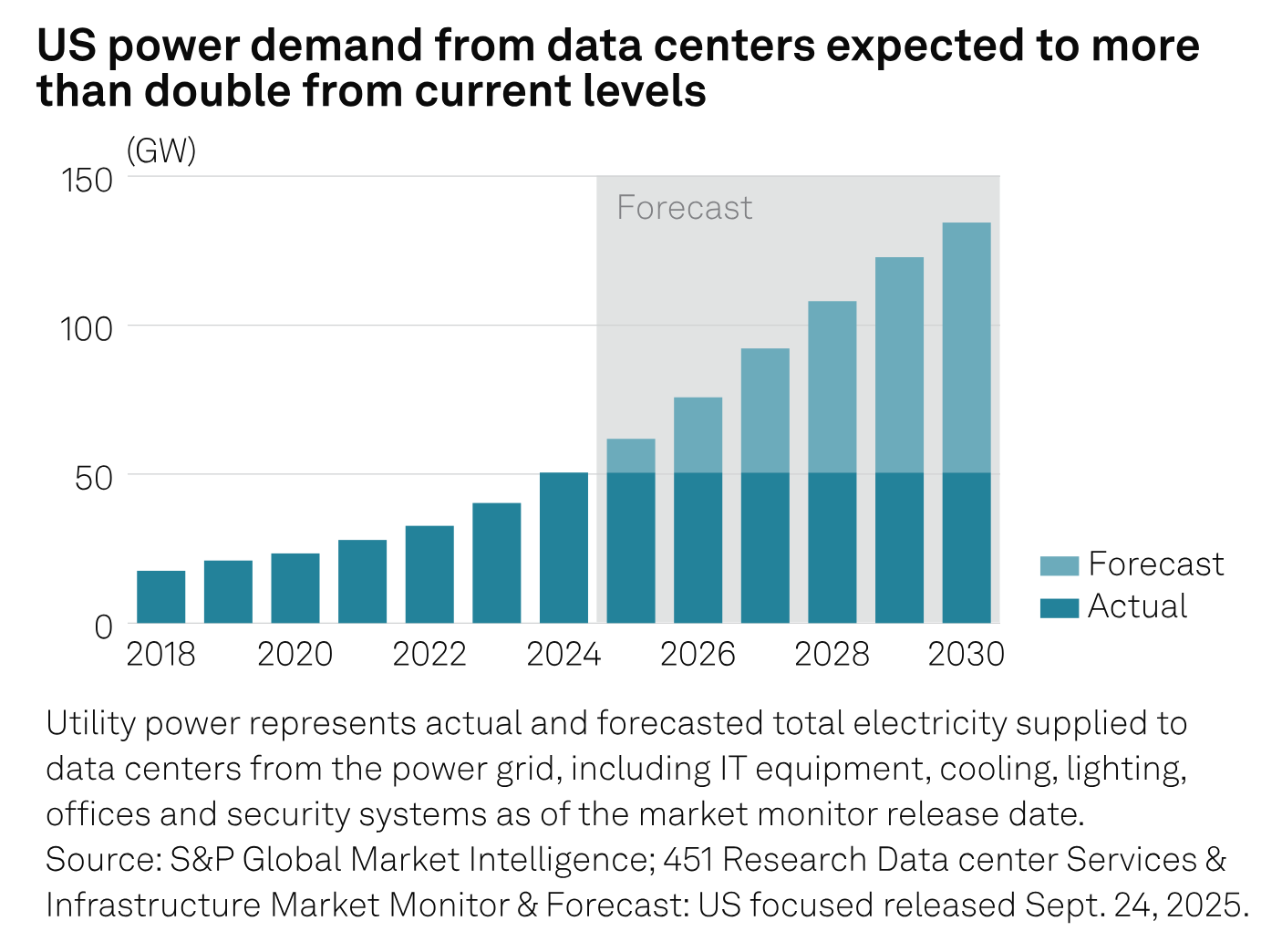
The numbers are staggering: data center grid power demand is expected to nearly triple by 2030, creating a need for roughly 60+GW of new firm capacity in a window of just a few years. Capital is already deployed. Land is already purchased. Chips are already ordered.
This is no longer a forecast. It is booked demand colliding with a grid that cannot metabolize it.
The AGI arms race makes this existential.
We are in a race where the winner will dominate the technologies of the 21st century — from scientific discovery to economic productivity to national security. Training and inference must occur on sovereign soil under sovereign authority. The stakes could not be higher.
It’s why we’re already seeing extraordinary moves. Elon Musk’s xAI has resorted to purchasing and shipping power plants from abroad and reassembling them on U.S. soil simply because the domestic grid and supply chain could not deliver fast enough.
Satya Nadella captured it perfectly in November 2025:
“The biggest issue we are now having is not a compute glut, but it’s power... If you can’t [get the builds done fast enough], you may actually have a bunch of chips sitting in inventory that I can’t plug in. In fact, that is my problem today.”
This is the new normal.
America is simultaneously building the most advanced AI infrastructure on Earth, accelerating electrification, and reindustrializing, each of which demands unprecedented quantities of reliable, firm power.
Right now, the systems that deliver that power are too slow, too bureaucratic, and too constrained.
This is both a profound challenge and a historic opportunity.
The challenge is to close the gap between explosive demand and sclerotic supply before it constrains American ambition. The opportunity is to reindustrialize the energy sector at the pace this moment demands, creating jobs, strengthening national security, and ensuring that the United States never again finds its future constrained by electrons.
Firm power is not optional.
It is the foundation of everything we’re trying to build.
And the time to act is now.